The Adapter Pattern is one of the foundational patterns introduced in the legendary “Gang of Four” (GoF) book — Design Patterns: Elements of Reusable Object-Oriented Software It’s a timeless design approach that allows software components with incompatible interfaces to work together seamlessly. Whether you’re coming from iOS, Android, backend, or frontend, understanding design patterns like … Continue reading 🧩 Leveraging the Adapter Pattern in Flutter — A Transferrable Skill for Every Software Engineer
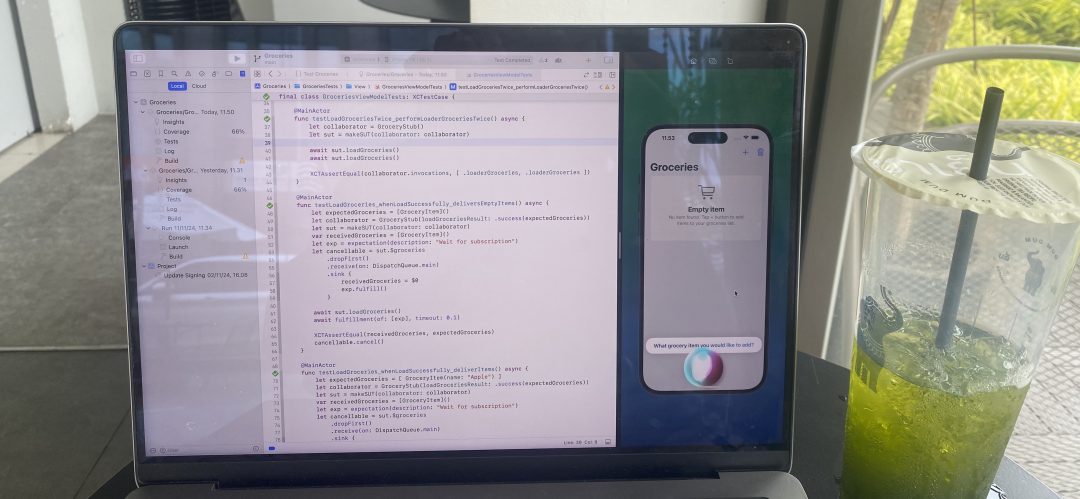
Speed coding – Unit Testing the MVVM in Swift
https://www.youtube.com/watch?v=eKtWY0962Hg 🎯 Difficulty: Intermediate to Advanced In this speed coding session, we write unit tests for a Swift ViewModel built with the MVVM architecture and powered by Combine and @MainActor concurrency. You’ll see how to: ✅ Write precise and meaningful unit tests using XCTest 🔍 Test async @MainActor functions with Combine’s @Published properties 🧪 Mock … Continue reading Speed coding – Unit Testing the MVVM in Swift
IOS Modularization and Unit Testing Feedback Speed
When an app is actively being developed, it tends to grow larger day by day. Over time, as engineers, we need to manage and maintain this growing codebase efficiently. If we don’t modularize it properly, we will eventually face significant challenges. Some of these include: Difficulty in maintenance Difficulty in adapting to new changes Slower … Continue reading IOS Modularization and Unit Testing Feedback Speed
Dependency Inversion Principle (DIP) in iOS Swift
The Dependency Inversion Principle (DIP) is a fundamental concept in software development that helps create flexible and maintainable code. In this article, I'll explore its history, the problem of tight coupling, and different approaches to applying DIP in Swift. History of the Dependency Inversion Principle The Dependency Inversion Principle (DIP) was introduced by Robert C. Martin, also known … Continue reading Dependency Inversion Principle (DIP) in iOS Swift
Understanding the Liskov Substitution Principle (LSP) in Swift
The Liskov Substitution Principle (LSP) is one of the five SOLID principles of object-oriented design. It states that: "Objects of a superclass should be replaceable with objects of a subclass without affecting the correctness of the program.” (Paraphrased from Barbara Liskov’s) Barbara Liskov, a pioneering computer scientist, introduced this principle in 1987 as part of her research … Continue reading Understanding the Liskov Substitution Principle (LSP) in Swift
Open/Closed Principle (OCP) in Swift using Decorator Pattern
SOLID: Open Close Principle Overview The Open/Closed Principle (OCP) is one of the fundamental principles of object-oriented design, forming part of the SOLID principles. The concept is simple: “Software entities (classes, modules, functions, etc.) should be open for extension, but closed for modification.” This principle encourages building systems where new functionality can be added without altering existing code. This leads to … Continue reading Open/Closed Principle (OCP) in Swift using Decorator Pattern
SOLID : Single Responsibility Principle (SRP)
What is SRP? The Single Responsibility Principle (SRP) is one of the SOLID principles in software design. It states that a component should have only one reason to change. In other words, a class, struct, or any components, should have a single purpose and should not be modified for multiple reasons. Consider the following Swift struct: struct … Continue reading SOLID : Single Responsibility Principle (SRP)
Clean Architecture: A Blueprint for Scalable and Maintainable Software
Clean Architecture is a software design philosophy that helps developers build flexible, maintainable, testable, and scalable applications. It emphasizes separation of concerns, ensuring that different parts of the application have clear responsibilities and do not mix unrelated logic. Think of it like designing a beautiful city with a well-planned infrastructure—roads, districts, utilities, and zoning regulations all working together efficiently. A well-architected city makes … Continue reading Clean Architecture: A Blueprint for Scalable and Maintainable Software
Simplifying Logic with Swift: From if-else to switch Pattern Matching
When working with conditional logic in Swift, you often encounter scenarios that require checking multiple conditions. Traditionally, developers rely on if-else statements for such tasks. However, Swift’s powerful switch statement with pattern matching offers a cleaner and more elegant way to handle these situations. In this article, we’ll demonstrate how to transition from a verbose if-else structure to a concise switch statement using pattern matching, … Continue reading Simplifying Logic with Swift: From if-else to switch Pattern Matching
Detecting and Fixing UI Hangs in iOS Applications
In this article, we’ll explore a common performance issue in iOS applications: the UI hang caused by heavy computations running on the main thread. We’ll cover how to detect hangs using tools like App Hangs Detection and Instruments, simulate a UI hang scenario in a SwiftUI project, and demonstrate how to fix it effectively. What is a UI Hang? A … Continue reading Detecting and Fixing UI Hangs in iOS Applications
 Arifin Firdaus Blog